
SelfSpeak journal
Why Your Own Voice May Make Affirmations Feel More Personal
Explore what research says about hearing your own voice, what remains unproven, and how to build a realistic personal affirmation routine.
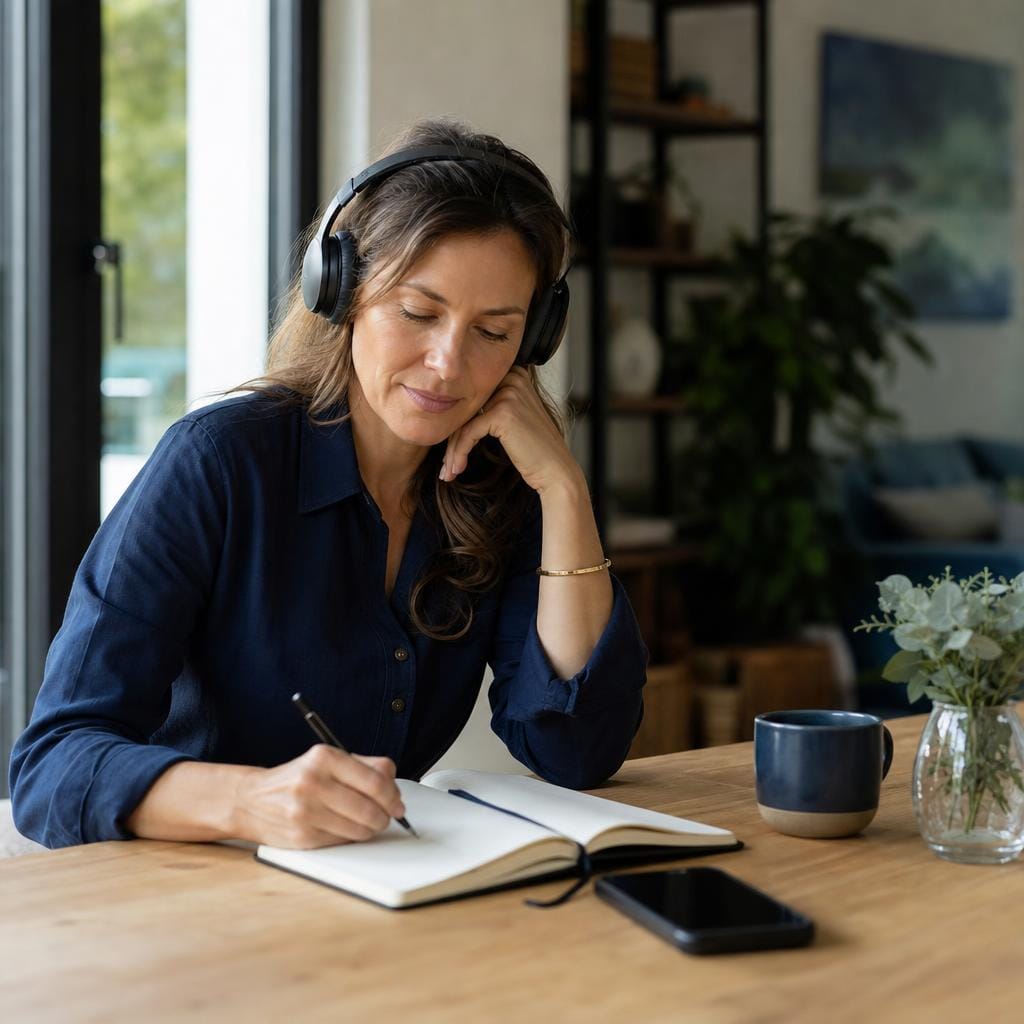
A familiar voice can make a listening experience feel personal. When the words also reflect your own goals, an affirmation routine becomes something you can shape rather than a recording you simply follow.
That is a reasonable reason to try affirmations in your own voice. It is not the same as saying neuroscience has proved they are more powerful than meditation apps, that they bypass skepticism, or that they create lasting change on their own. The research offers an interesting, more limited picture.
What happens when you hear your own voice?
Researchers have studied how the brain distinguishes a person's own voice from another person's voice. In a 2008 fMRI study, Kaplan and colleagues asked participants to listen to recordings of their own voice and a friend's voice. Hearing their own voice was associated with greater activity in the right inferior frontal gyrus, a region also involved in processing other self-related information.1
This supports the idea that voice identity can matter to self-related processing. It does not show that more activity means a better emotional outcome, stronger motivation, or more effective affirmations. Brain activation is a measurement, not a ranking of how helpful a listening experience will be.
What research on own-voice affirmations actually found
A small 2024 study by Jo and colleagues examined self-talk using sentences synthesized in participants' own voices or other voices. The experiment included self-affirmation, cognitive defusion, and neutral content. Cognitive defusion is a different strategy that involves creating distance from negative thoughts.2
Self-affirming sentences received higher emotional-influence ratings than neutral sentences. However, voice identity did not have a statistically significant main effect on those ratings, and there was no significant interaction between voice identity and strategy for that measure.
The brain-imaging results differed with the strategy being used; some own-voice differences were more pronounced for cognitive defusion than self-affirmation. It would therefore be misleading to present all the study's neural findings as evidence that own-voice affirmations work better.
The study is relevant because it used synthesized voices. But it did not test SelfSpeak, establish long-term changes in confidence or behavior, or compare an own-voice affirmation routine with meditation apps. A lack of a significant voice effect is not proof that the voices are equivalent in every setting; it means this study did not establish an advantage on that emotional measure.
Creating your own words and hearing your own voice are different
The generation effect is a well-established memory finding. In classic experiments, people remembered words they actively generated better than words they were simply given to read.3
That finding gives us a reason to distinguish actively creating content from passively receiving it. It does not prove that hearing a recording changes your beliefs, or that an AI-generated version of your voice will produce the same effects as generating words yourself.
For a personal routine, you can take an active role: consider your goal, review the wording, and revise anything that does not sound like something you would genuinely say. This is a practical suggestion, not a claim that the generation effect has clinically validated an affirmation app.
A realistic way to make a listening routine personal
You do not need a promise of brain “reprogramming” to experiment with a routine that suits you. Consider these approaches:
- Choose a specific goal. Focus on something you can act on, such as preparing for a difficult conversation or starting a task you have been avoiding.
- Use believable, natural language. An example might be “I can take one manageable step today,” rather than a sweeping promise that everything will go perfectly.
- Review the words yourself. Treat suggested affirmations as a starting point, not a statement you must accept.
- Connect listening with an action. After listening, identify one step that fits the goal. These suggestions are not a guaranteed method for changing behavior.
- Pay attention to your experience. If a sentence feels unhelpful or uncomfortable, change it or stop using it. There is no research-based requirement here to push through discomfort.
Your own voice may feel familiar, awkward, reassuring, or simply different. None of those reactions is proof that a deeper transformation is taking place. Personal preference is a valid reason to choose a voice, without treating that preference as a scientific superiority claim.
What about listening during sleep?
Sleep supports memory consolidation. In controlled targeted memory reactivation experiments, researchers have replayed sounds associated with material learned before sleep and measured later recall.4
That is not the same as playing positive messages all night to install new beliefs. The research cited here does not establish that sleep is the time when your brain is “most receptive to positive programming,” or that sleeping with affirmations produces lasting personal change. A listening routine does not need that promise.
Where SelfSpeak fits
SelfSpeak lets you create personal affirmations and listen to them in an AI-generated version of your own voice. Its practical appeal is personalization: your goals, words you can review, and a listening experience built around you.
That is different from claiming the app has been clinically validated or is more effective than meditation. Affirmations are not a substitute for professional mental health care. If you try a routine, approach it as a personal practice rather than a guaranteed treatment or outcome.
Explore SelfSpeak and decide whether a personal listening routine fits your day.
References
- Kaplan, J. T., Aziz-Zadeh, L., Uddin, L. Q., & Iacoboni, M. (2008). The self across the senses: An fMRI study of self-face and self-voice recognition. Social Cognitive and Affective Neuroscience, 3(3), 218–223. doi:10.1093/scan/nsn014.
- Jo, H., et al. (2024). Neural Effects of One’s Own Voice on Self-Talk for Emotion Regulation. Brain Sciences, 14(7), 637. doi:10.3390/brainsci14070637.
- Slamecka, N. J., & Graf, P. (1978). The generation effect: Delineation of a phenomenon. Journal of Experimental Psychology: Human Learning and Memory, 4(6), 592–604. doi:10.1037/0278-7393.4.6.592.
- Creery, J. D., Oudiette, D., Antony, J. W., & Paller, K. A. (2015). Targeted Memory Reactivation during Sleep Depends on Prior Learning. Sleep, 38(5), 755–763. doi:10.5665/sleep.4670.
Keep the conversation going
More thoughtful words, delivered.
Subscribe to the SelfSpeak blog for new stories by email.